
ERIK MUSALEM
I help CEOs make better decisions to build more valuable companies.

The role of an academic in the era of AI is to create a safe space to develop the one capability AI cannot replace: clear thinking.
"In a world where answers are abundant, the real advantage is knowing how to think."
Why this matters
The environment has changed.
Information is abundant, but clarity is not.
AI can generate answers, but it cannot determine which questions matter, what context is missing, or which trade-offs are worth making.
Leaders who rely solely on information risk making faster—but weaker—decisions.
Those who develop the ability to think clearly—frame problems, challenge assumptions, and prioritize effectively—build stronger organizations and create more value over time.

Credentials
My academic work is grounded in both formal training and real-world application.
I hold a PhD in Organizational Development, with a focus on leadership, human behavior, and the drivers of individual and organizational performance, as well as an MBA with a strong foundation in strategy, execution, and business performance.
I have taught more than 200 students across undergraduate, graduate, and executive education programs at leading institutions, translating complex concepts into practical frameworks that leaders can apply immediately.
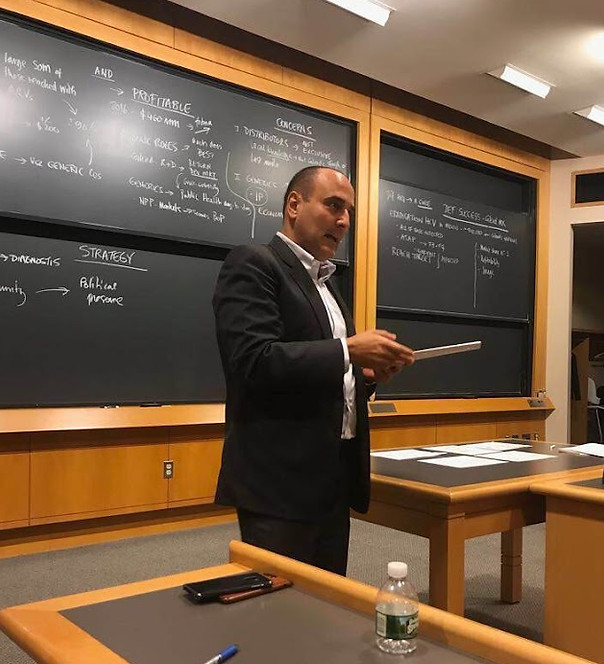
I have also served as a lecturer and guest speaker at Harvard, Santa Clara University, and Northeastern University, engaging diverse audiences on leadership, strategy, and organizational performance.
My approach to academia is practical by design. The objective is not to accumulate knowledge, but to develop capabilities—how leaders think, decide, and act. What is learned must translate into better judgment, stronger execution, and improved performance.
Teaching Experience


Guest Lecturing


